Technology is how we scale Social Truth. It is not what produces it.

Discovery requires reading enormous volumes of unprompted human conversation across platforms. No human team can do that alone. Our technology lets human analysts work at the scale the question requires - and stops there.

Where technology applies.

Stage 1

Sourcing

We identify the platforms, communities, conversations, and time windows where the category lives. AI scans the open web at scale, flags candidate sources, and prioritizes them by volume, recency, and relevance.

AI

Stage 2

Collection

Selected sources are scraped and stored. Volume varies by engagement - from tens of thousands of posts for a niche category to millions for a mainstream one.

AI

Stage 3

Pattern recognition and clustering

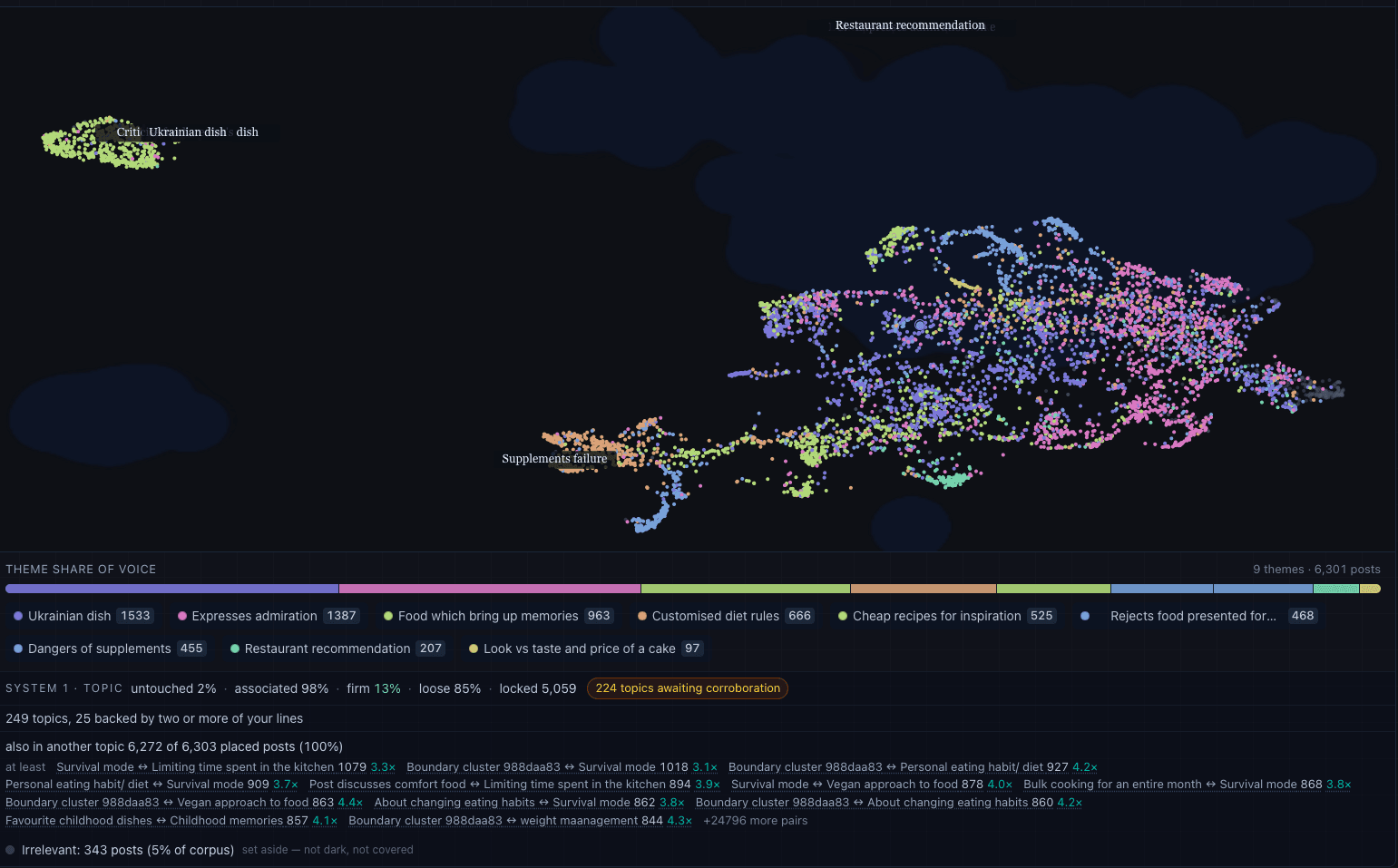
AI clusters the discourse by theme, language pattern, and emergent topic. Human analysts review the clusters, correct misreadings, merge what AI separated and separate what AI merged. Sarcasm, irony, coded language, and lived context require human judgment. Software cannot read culture, only count it.

Human + AI

Stage 4

Interpretation

The senior analyst reads the material, surfaces the constructs and tensions that organize the category, identifies the language consumers actually use, and writes the discovery architecture. AI is not used for interpretation. This is the work that determines whether the survey will measure reality or recreate the brief.

Human

Stage 5

Survey design and quantitative analysis

Sandra Baumann designs the survey instrument from the discovery architecture. AI assists with sampling logic, statistical analysis, and quality control on the fielded data. Interpretation of findings is human, in consultation with the discovery work.

Human + AI

AI lets us read at scale. Humans decide what was read.

The judgment is ours.

AI is a tool, not a researcher. It can read at scale, count at scale, cluster at scale. It cannot tell the difference between what a consumer says and what a consumer means. It cannot read a culture, only a corpus. The work that determines whether your study is right or wrong - what to look for, how to interpret what we find, what to build the survey around - is done by experienced researchers, with two decades of category knowledge between them. The technology serves the judgment, not the other way around.

See how Social Truth is made →