French Election Social Media Landscape Report 2017
Fake news, echo chambers and Russian influence in the 2017 French presidential election.
Around the 2017 French presidential election, Bakamo studied how French social media users shared news. The study mapped the media sources they linked to, the ways they shared them, and the patterns of disinformation that moved through the conversation.
This is the final report of the study. It summarizes the earlier phases and adds new findings on what people share, and why. You can read it on this page, or download the original.
Key Facts
The study at a glance
- Report
- The final report of a three-phase study: non-traditional media map, social media sharing behaviour, and patterns of disinformation. 175 pages. (Report, pp. 3, 41, 175)
- Period
- November 1, 2016 to May 22, 2017. (Report, p. 5)
- Sources
- Public conversation on Facebook, Twitter, blogs and forum sites, in French. (Report, pp. 5, 167)
- Volume
- More than 20 million social media conversations captured. Over 8 million shared links analyzed. 1,000+ media sources analyzed, 800 of them non-traditional. The research summary states that 50,000 social media posts were read and coded (p. 5); the methodology section describes 5,000 coded posts and 4,200 coded Facebook comments (p. 174). (Report, pp. 5, 174)
- Team
- Bakamo.Social and a team of over 20 analysts, with input from journalist Pierre Haski. Zsigmond (Fifou) Szabó, Balázs Berkovits and Blanka Réti contributed to the analysis. (Report, pp. 3, 5, 175)
- Support
- With support from The Open Society Foundation, which the report thanks for making the study possible. (Report, pp. 3, 175)
- Tools
- Talkwalker, a social media monitoring platform, for data collection. Posts and comments were coded manually, through human reading and interpretation. (Report, pp. 5, 167, 174)
Headline Findings
What the report found
57 percent of shared links pointed to traditional media or campaign sites. The other 43 percent pointed to non-traditional sources, which the report sorts into three sections: Extend (civic media adhering to journalistic standards), Reframe (sources aiming to counterbalance traditional media) and Alternative (publishers of conspiratorial and “confusionist” content). (Report, pp. 10–11)
The 800 non-traditional sources fell into 17 clusters. Three intertwined hard-right clusters resonated most: French Identity, Anti-Islam and Anti-Global Patriots. (Report, pp. 13–14)
There was virtually no common ground. Users overwhelmingly shared links from only one section of the media map. Of the top 100 sharers by number of followers, no more than 3 shared content across the divide between traditional media and Reframe and Alternative sources. (Report, pp. 17, 19, 86)
Four disinformation tactics were identified: credibility cloak, time shifting, fake polls and hoax sites. All aim to co-opt the trustworthiness of traditional media while undermining it. Sharing behaviour suggests these campaigns resonate on an emotional level. (Report, pp. 16, 90)
The only foreign influence detected among the media sources was Russian, seen in citations of broadcasters such as RT and Sputnik and in French-speaking Russian news blogs. The report notes that its approach identifies correlation, not causality. (Report, pp. 17, 51–52)
Read the report
The original is a 175-page slide deck. What follows is the same report as a page you can read: its argument, its numbers and its examples, in the order the report gives them.
01
Why the study was done
Social media hosts a significant part of public discourse and has a growing effect on people’s opinions and choices. The Internet has changed how people come across news, and it has reduced the role of information gatekeepers such as traditional media. (Report, p. 2)
By 2017 the debate was fuelled by the perceived rise of disinformation (fake news, manipulation and foreign influence) in elections in the United Kingdom, the United States and Colombia. None of these were new. Their spread through social media was. (Report, p. 2)
The study set out to map the space between the news media and their audiences in the months before the French presidential election: what kinds of content circulated, how people behaved with it, and how disinformation moved. It is an exploratory study. It confirms three assumptions that were widely held at the time: that far-right media content had a massively outsized presence in French social media, that manipulation techniques were used to boost it, and that Russian attempts to influence French media reporting before the election were real. (Report, pp. 3–4)
02
The Media Map
The Media Map charts the sources French social media users linked to when they talked about the election, the candidates, the parties or the issues. The more often users shared links to a source, the larger it appears on the map. Five types of source were publishing content relevant to the public discourse. (Report, pp. 10, 44)
- Traditional
- 50%
- Commercial and public news organizations: national and regional newspapers, TV and radio stations, online portals adhering to journalistic standards, and news aggregators.
- Campaign
- 7%
- The official web presences of candidates and parties, including local and regional party chapters.
- Extend
- 20%
- Civic media that extend the journalistic scope of traditional media: investigative reporting, anti-corruption watchdogs, personal and community perspectives, petitions and humour.
- Reframe
- 19%
- Sources that set out to counter the traditional media narrative and “re-inform” readers. This section breaks with the traditions of journalism and expresses radical opinions.
- Alternative
- 4%
- An incoherent, confusing space that fuses radical left and right views, unified in their opposition to globalization. Narratives are often mythical or conspiratorial.
The percentages are each section’s share of shared links. Traditional media and campaign sites together account for 57 percent. The other 43 percent points to non-traditional sources, and the study concentrates on those three sections. (Report, pp. 11, 44–45, 47)
Sharing rose as the election came closer. New users joined the conversation steadily, and each user shared more. Traditional and campaign sources gained most: in April, almost two thirds of the content shared came from traditional news or official campaign sources. Non-traditional sources did not benefit as much from the extra attention, but remained a significant part of the discourse. (Report, pp. 53–54)
03
Two narrative frames
Sources position themselves through a narrative frame, a binary opposition that organises how they present the world. The study found two. (Report, pp. 12, 46)
Left versus right
The established frame. It works for traditional media, and for the Extend section, where sources may hold opposing views but still argue along the same left-to-right line. It applies less to Reframe sources, and content in the Alternative section cannot be classified by it at all. (Report, p. 46)
Global versus local
The further a source sits from traditional media, the less a left or right label fits. In its place is a divide that pits globalization and transnational organizations against local, patriotic interests. Hard-left and hard-right Reframe sources converge here. They differ mainly in their attitudes to Islam and migrants, and otherwise share one enemy: globalization and the liberal economics associated with it. Alternative sources are fully immersed in this frame. (Report, pp. 12, 46)
04
17 clusters of non-traditional media
The study took the 800 non-traditional sources shared most often and grouped them by what they publish, the narrative frame they use, who they reject, who they cite, how they look, which candidates they support, whether they show Russian influence, and whether they carry advertising. The result is 17 clusters. (Report, pp. 14, 47)
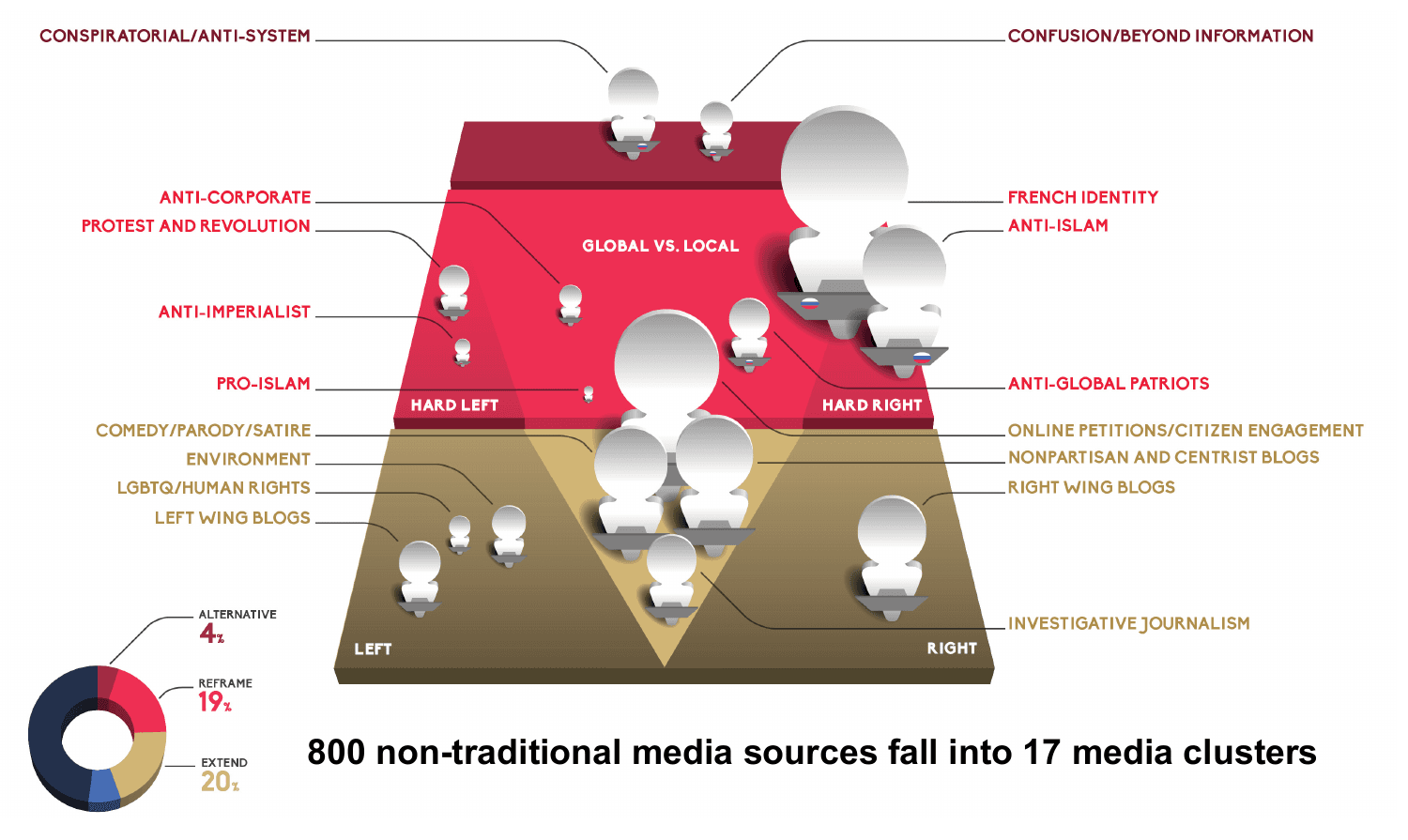
Extend
- Comedy / Parody / Satire
- Online Petitions / Citizen Engagement
- Nonpartisan and Centrist Blogs
- Investigative Journalism
- Environment
- LGBTQ / Human Rights
- Left Wing Blogs
- Right Wing Blogs
Reframe
- French Identity
- Anti-Islam
- Anti-Global Patriots
- Anti-Imperialist
- Anti-Corporate
- Protest and Revolution
- Pro-Islam
Alternative
- Conspiratorial / Anti-System
- Confusion / Beyond Information
The Extend section is dominated by petition sites, comedy and non-partisan blogs. The Reframe section is dominated by three hard-right clusters that are closely intertwined: French Identity, Anti-Islam and Anti-Global Patriots. These three resonated most of all non-traditional sources. (Report, pp. 13–14, 48)
Who the clusters supported
A large share of non-traditional sources openly backed a candidate, and support was strongest for candidates with an anti-establishment agenda. Marine Le Pen and the Front National dominate the largest clusters. Sources in the French Identity cluster overwhelmingly supported her, with a few backing François Fillon. In the Anti-Islam cluster she was the only candidate supported. (Report, pp. 17, 50)
The Anti-Global Patriots cluster supported both Le Pen and Jean-Luc Mélenchon, two candidates traditionally placed at opposite ends of the spectrum. On the left of the Reframe section, the Anti-Corporate and Anti-Imperialist clusters mainly supported Mélenchon and Philippe Poutou and, to a limited extent, Le Pen. The report reads this as further evidence that the global versus local frame is superseding left versus right. (Report, p. 50)
05
Foreign influence
Each source was checked against four criteria: overt support for a foreign nation’s views or policy goals, use of foreign media to counter traditional media narratives, recommendations of and links to foreign media, and French-language sources operated from abroad. At least five articles from each source were read, along with the source’s permanent content. (Report, p. 51)
The only foreign influence the analysis identified was Russian. It shows in citations of Russian broadcasters such as RT and Sputnik, and in a range of French-speaking Russian news blogs. Some sources are marked as Russian outright, and some link directly to Russian government institutions. (Report, pp. 17, 51–52)
- In the Alternative section, almost half of the sources in both clusters show signs of Russian influence.
- In the Reframe section, one third of the sources in the French Identity and Anti-Islam clusters show such signs, as does one third of the hard-left Anti-Imperialist cluster. In Anti-Global Patriots it is one tenth.
- The impact is greatest on the far right, because those clusters reach a much larger audience.
Russian content tends to be set against stories reported by traditional media, to show that traditional media does not tell the whole story. A dominant theme is the war in Syria and the refugee crisis. (Report, p. 52)
The report is explicit about the limit of this finding. Its approach is not suited to detecting intentional manipulation or state-sponsored campaigns. It identifies correlation, not causality. (Report, p. 52)
07
Four disinformation tactics
Sources in the Reframe and Alternative sections seek to counter traditional media narratives. The study observed four patterns by which false or deliberately confusing information entered the discourse. They share one strategy: borrow the authority of traditional sources while using it to undermine them. The result is a general sense of distrust and chaos, which makes radical solutions more appealing. (Report, p. 90)
Credibility cloak
Respected outlets host open platforms where anyone can publish. A false story placed there is then presented as if the outlet itself had reported it. The campaign linking Emmanuel Macron to offshore funds began with an article on the open collaborative blog attached to Mediapart. It never explicitly accused Macron, but the suggestion spread through the hashtag #EmmanuelCahuzac, shared by people who believed, or pretended to believe, that Mediapart was the author. A more radical version alleges censorship: one site claimed that an investigative newspaper held a report on Macron’s offshore accounts and that its own editors had censored it. (Report, pp. 91–92)
Time shifting
Information that was true when it was published is recycled, often without its date, to give the impression that it still holds. In April an article announced that François Fillon had been cleared in the “fake job” scandal, citing a lawyer’s opinion from the end of February. Fillon had been indicted a month after that opinion was given. (Report, p. 93)
Fake polls
Unscientific polls were published in the months before the vote, alongside the claim that traditional polling was biased towards the candidate of the elite. On 29 March, Sputnik reported a poll by Brand Analytics, a Moscow-based social media company, that showed Fillon in the lead. Reframe sources cited it as proof that classical polling was unreliable. That these polls proved inaccurate is immaterial. They created uncertainty and undermined legitimate polls. (Report, pp. 16, 94)
Hoax sites
Cloned websites imitated reputable ones. LeSoir.info copied the look of the Belgian newspaper site LeSoir.be to publish a false allegation that Macron received financial support from Saudi Arabia. Another site imitated LinkedIn to post a fake, disparaging profile of Macron. (Report, p. 95)
Sharing behaviour suggests these campaigns work on an emotional level. People understand the information to be false, yet pass it on to soothe their anger. (Report, p. 16)
08
What it means
There is virtually no common ground
Public discourse needs people to see and understand views other than their own. The study found the conversation around the election partitioned into two camps: traditional media and the Extend section on one side, the Reframe and Alternative sections on the other. The second camp is home to multiple echo chambers. Its sources define themselves by “re-information”, the need to counter an alleged elitist deceit, and their content reduces the chance of common ground with anyone who does not already share their view. (Report, pp. 19–20)
Fake news is emotional, not factual
Fake news stories are episodic bursts. They grow out of the counter-narratives of the Reframe and Alternative sections, and the two cannot be separated. Counter-narratives speak to frustration and fear, and they raise a user’s sense of self-worth. A fake story works as a proof-point for the counter-narrative, and efforts by traditional authorities to debunk it only reinforce its credibility. (Report, pp. 21–22)
Narratives travel along three routes
Extend publications elaborate on and critique traditional media. Reframe sources use the conspiratorial narratives of Alternative sources to prove traditional media wrong, exposing a broader audience to them. And both Reframe and Alternative sources cite French-language content from Russian sources, which gives the counter-narrative a constant stream of stories. (Report, p. 23)
By sharing, people seek community and identity
Users form a symbolic relationship with the publications that match their views. The publication says what resonates, and the audience takes it upon itself to amplify it. The exchange confirms a feeling: “My opinion is that of many.” The quest for belonging is a strong driver of behaviour, most visibly around Reframe and Alternative sources, where sharing polarizing content becomes a display of identity. The report reads this as a sign that these users experience insecurity and emotional distress in everyday life. (Report, pp. 24–25)
Debunking has its limits
Fact-checking is necessary but has limited impact, and may backfire. Refutations do not reach the people who posted the story, and may be read as confirmation that it was true. Reframe and Alternative media run their own counter fact-checkers. And fighting false stories one by one leaves the larger counter-narrative, and the issues that inspired it, untouched. (Report, p. 26)
09
Recommendations
The recommendations rest on one premise: open, successful, democratic societies require a healthy public discourse. (Report, p. 27)
For media organizations
The study indicates that about one third of the audience has disengaged from traditional sources of information. To win it back: address contentious topics such as national identity, community and migration in non-nativist frames; simplify language and avoid labels, which create distance; tell audiences that the counter-narrative exists; and give hostile audiences space to voice their concerns. (Report, p. 29)
For social media platforms
Platforms are part of the infrastructure of public discourse, and their business interest is time on site, not common ground. The report asks them to discourage the Repeat behaviour and rank meaningful conversations higher; to fight botnets and eliminate fake accounts; to make the mechanisms that select and prioritize content understandable to any member of the public; to make all paid political communication public; and to take active steps against echo chambers, including exposing segregated communities to other views. (Report, pp. 30–35)
For regulators and political actors
Regulators should educate citizens about personalization and targeting, create a legal framework that enforces transparency on moderation, content prioritization and targeted dark advertising, and monitor and publish campaign spending. Political actors should adhere to a transparent code of conduct covering their data operations, their targeting of voter segments and their use of dark advertising. (Report, pp. 36–37)
For citizens
Follow people you do not agree with. Do not simply share articles: say what they mean to you. Pay for journalism. Explore the media landscape and be your own fact-checker. Press the platforms to change. (Report, p. 38)
10
Methodology
The method combines technology with human qualitative analysis at scale, and is built to discover what users share and why. Every insight in the report comes from public social media conversation. (Report, p. 42)
Data was collected with Talkwalker using several hundred keywords in four categories: election terms, candidates, parties and issues. A comment had to be in French and had to contain a shared link. The resulting dataset held over one hundred million comments, of which a random sample of 300,000 was downloaded for further processing. (Report, p. 167)
Posts and comments were then coded by hand, through human reading and interpretation. A random sample was drawn for each cluster: 5,000 posts in total, and 4,200 Facebook comments on those posts. (Report, p. 174)
The full report adds a cluster-by-cluster analysis with quoted posts, and the five steps used to build the Media Map. Download it as a PDF.
Cite this report
Bakamo (2017). French Election Social Media Landscape Report 2017. https://www.bakamosocial.com/frenchelection
The report was published under the name Bakamo.Social.