Public Sector

Social intelligence for government and not-for-profit

How a contested issue is being argued, by the people arguing it.

A poll tells you how many people agree with a statement. It does not tell you which statement they would have made themselves.

We read the public conversation around an election, a policy or a contested issue, and map the narratives, frames and divides that organise it. Our public studies of the French election, migration narratives across the EU and the Hungarian election were made this way.

Where we start

Questions we are brought

  • Which narratives are carrying this debate, and where do they come from?
  • Who is in the middle, and what language loses them?
  • How does the same issue read from one country and language to the next?
  • Is disinformation moving, and through which sources?
  • What should the survey ask, before it is fielded?

Human analysts read the material. The Reading Machine holds the whole conversation at once, so nothing is left out because it did not look interesting. Interpretation stays with the researcher. How the work is done

From the Atlas of Social Truths

What we found when we listened

Cases

  1. IThe Hungarian Election, 2026Public sphere, Europe
  2. IIAmsterdam's Ad Ban: a meat debate in disguisePublic sphere, Europe
  3. IIIThe French Election, 2017Public sphere, Europe
  4. IVMigration Narratives in EuropePublic sphere, 28 EU member states

I

Public sphere, Europe

The Hungarian Election, 2026

A polarised electorate is not divided by what people want. It is divided by two opposing psychological architectures — the Employee, who locates safety inside the system, and the Entrepreneur, who locates it in personal agency. Identity comes first. Politics follows.

See the study: The Hungarian Election, 2026

II

Public sphere, Europe

Amsterdam's Ad Ban: a meat debate in disguise

On May 1, Amsterdam introduced an ad ban on meat and fossil-fuel products. We explored the reactions of social media users across various channels. The language was English.

What we found is that the discourse predominantly focuses on the meat part of the ban, and to a significantly lesser extent on the fossil-fuel part. The fossil-fuel half is largely waved through as common sense. The meat half is where the conversation concentrates.

By and large, opinions fall into two opposing sides — and which side people land on tends to track whether they're an omnivore or follow a meat-free lifestyle. In this discourse, diet predicts stance more reliably than politics.

Supporters celebrate the policy. They expect that reducing the visibility of meat will normalise vegetarian and vegan options over time, underpinned by a belief that less advertising means meat stops being the default. Other supportive arguments include retribution for the environmental damage attributed to the meat industry, and a smaller group who back the ban because they think fewer ads would have a calming, aesthetic effect on the quality of city life. The stance is anchored in a self-identity as environmentally conscious and forward-looking.

Opponents read the ban as an attack on a normal, everyday way of life — elitist, performative, and a step toward broader censorship. A recurring move is whataboutism: gambling ads are permitted, but meat is where the line is drawn? The register here is largely ridicule and sarcasm rather than evidence, while the supportive side tends toward research, precedent, and moral framing. As a result, the two camps rarely engage directly.

Beneath the meat divide sit two deeper questions that also separate the camps: whether advertising actually changes behaviour, and whether a collective authority should decide what may be promoted. The fossil-fuel half of the ban functions as a useful point of comparison — the same policy, the same city, and the same censorship objection available, yet only meat generates sustained debate. In this discourse, the stronger driver of reaction is dietary identity rather than free-speech principle.
III

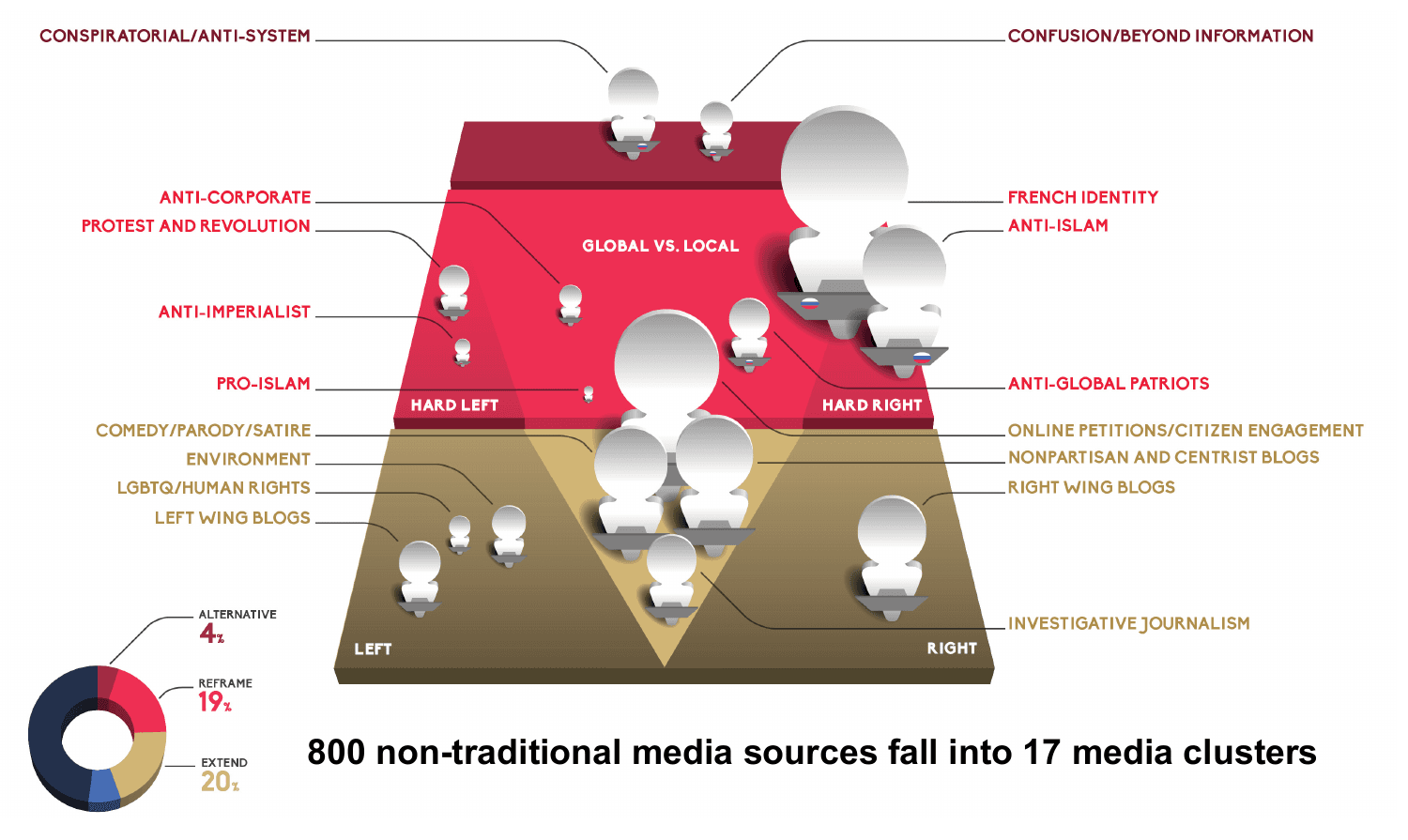
The Media Map from the report: 17 clusters of non-traditional media sources.

Public sphere, Europe

The French Election, 2017

8M
shared links
1,000+
media sources
17
clusters

Around the 2017 election, French social media had virtually no common ground. People shared links from one side of the media map or the other, and almost never both. Fake news travelled because it answered an emotional need, not because it was believed.

See the study: The French Election, 2017

IV

Public sphere, 28 EU member states

Migration Narratives in Europe

28
EU member states
5
narrative frames

Across 28 EU countries, migration is argued through the same few frames: security, identity, economy and demographics, humanitarianism, and distrust of the political establishment. What changes from country to country is their weight.

See the study: Migration Narratives in Europe

Two ways to work with us

The Full Social Truth Study
Discovery through measurement, led by the Bakamo team. A written report, a presentation to your team, the discovery architecture and the full quantitative dataset.
Better Surveys for Your Team
The discovery phase only, delivered as an instrument-design input for your in-house or agency quant work.

Among those we have worked with: Open Society Foundations, Friedrich Ebert Stiftung, Ofcom, Pew Research Center, Parliament of Victoria, McCain Institute / Arizona State University, Greenpeace.